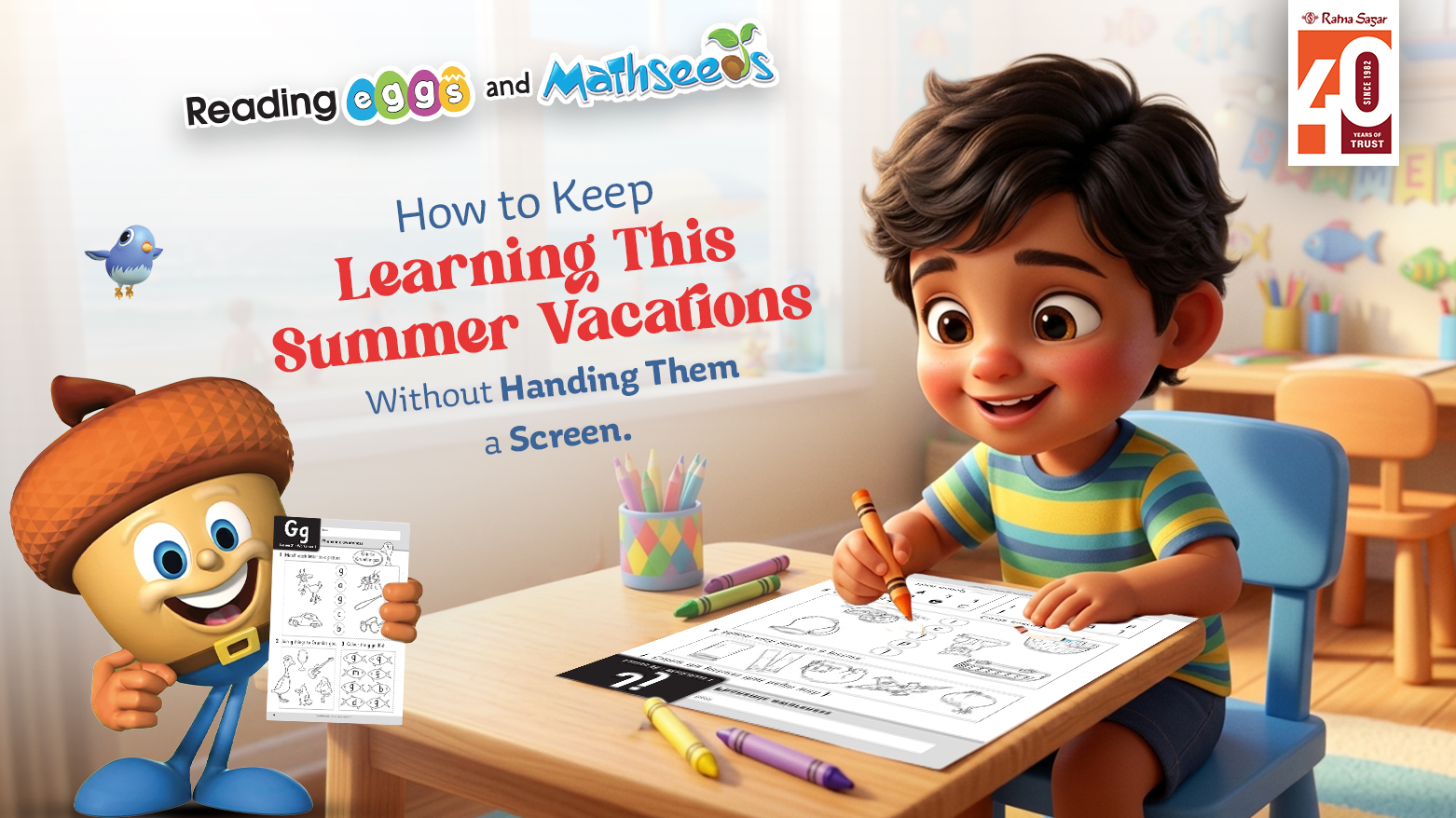
How to Keep Kids Learning This Summer Without Handing Them a Screen
Summer holidays are supposed to be joyful — lazy mornings, trips to the park and ice cream after lunch. But ask any parent a fortnight in and you'll hear the same story: the telly is on, the tablet is out and the only exercise happening is a thumb scrolling through cartoons.
The good news? Keeping young children engaged in learning doesn't have to mean endless screen time or turning your living room into a classroom. With the right tools and a little creativity, you can make this summer genuinely enriching — and surprisingly fun.
Why Screen-Free Learning Matters in the Early Years
Before jumping into activities, it's worth understanding what's at stake. Children in nursery, LKG, UKG and Classes 1–2 are at a critical developmental stage. The FLN full form in education — Foundational Literacy and Numeracy — is a national priority in India and for good reason. Research consistently shows that children who build strong reading and number skills early are better equipped for everything that follows.
Summer is not a break from growth. It's an opportunity to consolidate what was learnt during the school year and gently prepare for what's ahead — without pressure.
Start With Worksheets That Don't Feel Like Homework
The word "worksheet" can make children (and parents) groan, but the right ones feel more like puzzles than tests.
For LKG children, focus on letter recognition, simple phonics and number tracing. A good English worksheet for LKG might ask children to match pictures to their starting letters or colour objects beginning with a particular sound. These activities sharpen attention and build early reading habits in a playful way.
For UKG learners, you can introduce simple sentences, two-letter and three-letter words and basic addition. UKG maths worksheets PDF formats work brilliantly because they're printable, reusable and don't require any screen time at all. Look for LKG worksheets PDF free download options online — many are available free of cost and cover everything from alphabet writing to pattern recognition.
For Class 1 and Class 2 children, worksheets can include short reading passages, fill-in-the-blank grammar exercises and two-digit addition or subtraction. An English worksheet for Class 2 that covers nouns, action words, or simple comprehension keeps the brain ticking without any pressure.
Platforms like Reading Eggs & Mathseeds offer structured, curriculum-aligned resources for young learners that make it easy to find the right material for your child's level.
Build a Loose Daily Rhythm (Not a Timetable)
Children don't thrive under rigid schedules during holidays — but they do benefit from rhythm. A loose morning routine that includes 20–30 minutes of quiet activity, one physical game outdoors and some free play is more than enough.
Try something like this:
- Morning: One printed worksheet (maths or English) with a small reward afterwards
- Mid-morning: Outdoor play or a creative activity like drawing or clay modelling
- After lunch: Reading time — even picture books count enormously
- Evening: A family game, storytelling, or cooking together (measuring ingredients is secret maths!)
The key is consistency, not intensity.
Make Literacy Part of Everyday Life
You don't need worksheets for everything. Literacy is everywhere once you start looking.
Point to signboards and ask your child what letter they start with. Read cereal boxes at breakfast. Ask them to "write" the shopping list in their own way — even scribbles become purposeful when children believe they're helping. These micro-moments reinforce class 1 English and early reading skills without any formal effort.
Sight words are another brilliant tool. These are high-frequency words like "the," "is," "and," and "was" that children are expected to recognise instantly rather than sound out. Write them on small cards and stick them around the house — on the fridge, the bedroom door, the bathroom mirror. A few minutes of casual practice each day adds up to real fluency over six weeks.
Don't Neglect Maths — Make It Physical
For younger children especially, maths is most powerful when it's physical. Counting steps on the staircase, sorting socks by colour, grouping fruits into sets — all of this builds the number sense that formal UKG maths and LKG worksheets maths are trying to develop.
Board games involving dice are excellent for number recognition and basic addition. Even simple card games help children understand more and less, higher and lower.
For structured practice, UKG maths worksheets PDF with visual aids — pictures of objects to count, number lines, dot patterns — are far more effective than abstract sums on a page.
A Final Word for Parents
You don't have to do it all perfectly. Some days your child will be enthusiastic; other days they won't want to touch a pencil. That's completely normal. The goal isn't to replicate school at home — it's to keep curiosity alive.
Pick one or two activities a day. Celebrate effort, not just results. And when in doubt, read together. A child who loves stories will never truly stop learning.
For printable worksheets, activity ideas and curriculum-aligned resources for LKG, UKG and early primary classes, visit Reading Eggs & Mathseeds — a trusted platform designed to support young learners at every step.