How to Teach a Child to Read at Home in 30 Days — Step-by-Step Guide
Every parent remembers the moment their child reads a word on their own for the very first time. The eyes go wide. There's a pause. Then a grin that fills the whole room.
That moment doesn't happen by accident — but it also doesn't require a fancy curriculum, a tutor, or hours of daily drilling. What it requires is consistency, the right approach, and a parent willing to sit beside their child for twenty minutes a day.
This guide will show you exactly how to do it — step by step, over thirty days.
Before You Begin: Understanding How Children Learn to Read
Reading is not a single skill. It's a bundle of abilities that develop together — recognizing letters, connecting sounds to symbols, blending those sounds into words, and finally making meaning from what's on the page.
Most children between the ages of 3 and 6 — nursery through to Class 1 — are at precisely the right stage to begin this journey. Whether your child is in LKG, UKG, or just starting Class 1, the foundation is the same: phonics first, then sight words, then fluency.
One important thing to keep in mind: every child learns at their own pace. Thirty days is a framework, not a finish line. Some children will race ahead; others will need more time on certain steps. Both are completely normal.
Week One (Days 1–7): Letters, Sounds & the Alphabet
Days 1–3: Alphabet Recognition
Begin with what your child already knows. Go through the alphabet together and note which letters they recognise confidently and which ones they confuse or skip. Most children muddle b/d, p/q, and m/n — this is developmentally typical.
Use LKG English worksheets PDF that focus on letter tracing and identification. Tracing is not just handwriting practice — it builds a physical memory of each letter's shape, which reinforces recognition when reading.
Limit each session to 15–20 minutes. Attention spans at this age are short, and ending on a high note is always better than pushing too far.
Days 4–7: Letter Sounds (Phonics)
Once your child can name the letters, shift focus to their sounds. This is the heart of phonics — understanding that "b" says /b/, "s" says /s/, and so on.
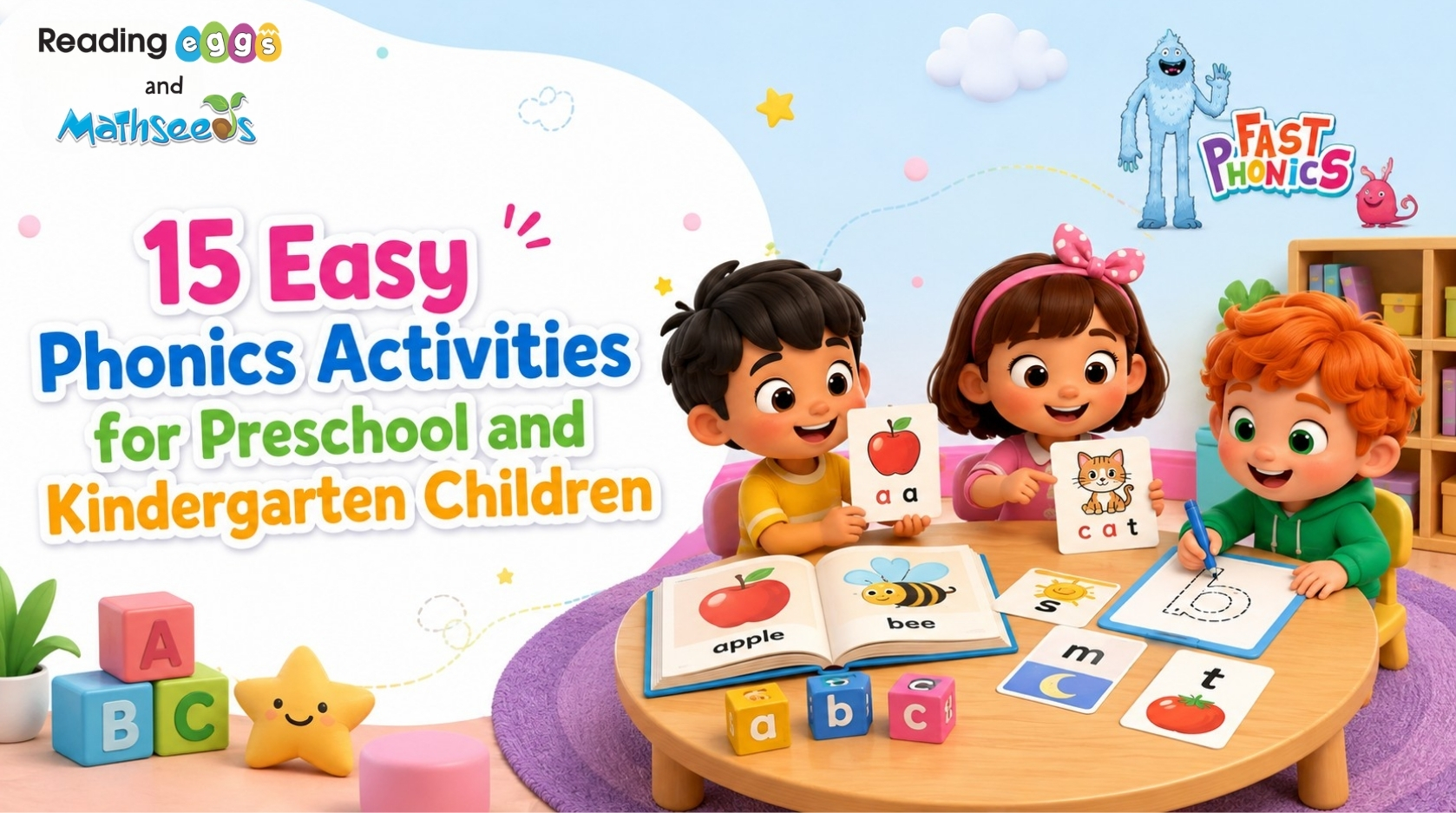
Start with the most common consonants: s, a, t, p, i, n. These six letters alone can form dozens of simple words. Use picture cards, songs, or simple UKG English worksheets that pair letters with familiar images — "a for apple," "s for sun."
Avoid alphabet songs that name letters without sounds. At this stage, the sound matters far more than the letter name.
Week Two (Days 8–14): Blending Sounds Into Words
Days 8–10: CVC Words
CVC stands for Consonant-Vowel-Consonant — words like "cat," "sit," "top," and "hen." These are the first real words most children learn to decode, and they're genuinely exciting because a child can hear themselves reading.
Stretch each sound slowly: /c/… /a/… /t/… cat! Let your child do the blending themselves as much as possible. Resist the urge to jump in. That pause before the word clicks is where the real learning happens.
English worksheets for UKG CBSE pattern resources are particularly useful here, as they're aligned with what Indian schools expect and typically include well-sequenced CVC blending exercises.
Days 11–14: Short Vowel Families
Group words into families — the "-at" family (cat, bat, rat, mat), the "-in" family (bin, fin, pin, tin). Word families make patterns visible and help children generalise rather than memorising each word individually.
Write the family ending on a card and swap the first letter. Make it a game: "What happens if I put 'h' in front of '-at'?" Children love the puzzle of it.
Week Three (Days 15–21): Sight Words & Simple Sentences
Days 15–18: Introducing Sight Words
Not all words follow phonics rules. Words like "the," "was," "said," "they," and "once" need to be memorised on sight — which is exactly where the term comes from.
Sight words for kids are typically introduced in sets of five to ten at a time. Write each word on a card and practise daily recognition. Flash them quickly — if your child needs more than two seconds, it needs more practice. Stick cards around the house in places your child will naturally see them.
Many English worksheets for Grade 1 include dedicated sight word sections, which are worth printing and working through systematically during this week.
Days 19–21: Reading Simple Sentences
Now combine what your child knows. Write simple sentences using CVC words and sight words they've already learnt: "The cat sat." "A big red hen." "I can run fast."
Read them together first, then ask your child to read them back. Celebrate every attempt, not just the perfect reads. Struggling through a sentence and getting it right is far more valuable than breezing through something too easy.
Week Four (Days 22–30): Building Fluency & Confidence
Days 22–25: Short Decodable Books
By now, your child should be able to tackle very simple books — the kind where each page has one or two short sentences and a matching picture. These are called decodable readers, and they're designed specifically so that children can apply their phonics knowledge independently.
Read together: you read a page, they read a page. This shared approach reduces pressure and models fluent, expressive reading at the same time.
For supplementary practice, UKG English worksheets PDF with short reading passages and comprehension questions are excellent — they build the habit of reading for meaning, not just decoding sounds.
Days 26–28: Revisit & Reinforce
Use these days to go back over anything that felt shaky. Common sticking points include blending without breaking words into too many pieces, remembering sight words under pressure, and distinguishing short vowel sounds (particularly 'e' and 'i').
Don't treat revision as failure. Treat it as what it actually is — the brain doing its most important work.
Days 29–30: Read Something Real
End the month by reading something that feels real and meaningful to your child. A short picture book. A birthday card. A simple recipe. A page from a magazine.
This is the moment learning becomes literacy — when a child understands that reading is not a school subject but a superpower they'll carry for the rest of their life.
Practical Tips to Make Every Session Count
Keep sessions short and consistent — twenty minutes daily beats two hours on a Saturday. Always end with something your child can do successfully, so they walk away feeling capable rather than frustrated. Use a variety of formats: worksheets one day, flashcards the next, reading aloud together the day after. Variety prevents boredom and reaches different learning styles.
For structured, curriculum-aligned worksheets across all levels — from nursery through to Class 2 — Reading Eggs & Mathseeds is a reliable resource that Indian parents and educators trust. You'll find everything from alphabet tracing sheets to CBSE-pattern reading exercises, all printable and ready to use.
A Word of Encouragement
Teaching your child to read is one of the most meaningful things you will ever do together. There will be days when nothing seems to stick and days when they suddenly leap forward with no warning at all. Trust the process, trust your child, and trust yourself.
Thirty days from now, they'll be reading. And you'll both remember it forever.