Vocabulary Before School: What Every Child Should Know Before Class 1
Starting Class 1 is one of the biggest transitions in a young child's life. Suddenly, they are expected to follow instructions, engage with stories, answer questions, and express themselves — all within a structured classroom setting.
What makes this leap so much easier? Words.
A strong vocabulary is the single most reliable predictor of school readiness. Children who arrive at Class 1 knowing a solid foundation of words are better equipped to understand their teacher, participate confidently, and grasp new concepts faster. The good news is that building this foundation does not require flashcards and drills. It happens naturally — with the right support.
Here is everything parents need to know about vocabulary words for kids before Class 1, and how to make sure your child is genuinely prepared for that very first school day.
Why Vocabulary Matters Before Class 1
Research in early childhood education consistently shows that vocabulary size at school entry is a strong predictor of reading ability, comprehension, and academic achievement throughout primary school.
When a child hears the word "subtract" in maths class but has no idea what it means, learning stalls. When they read a sentence about a "forest" but have never encountered that word, comprehension breaks down.
Vocabulary is not just about knowing words — it is about building the mental framework through which children understand everything around them. The richer the vocabulary, the richer the learning experience.
A child entering Class 1 ideally should be comfortable with words across several important areas of life and learning:
- Classroom language — words like listen, question, lesson, and read that structure how school works
- Number and maths language — words like count, add, more, less, equal, and shape that form the basis of early numeracy
- Descriptive language — words that describe size, colour, texture, and feeling, such as smooth, bright, heavy, and narrow
- Nature and the world — words like weather, season, plant, ocean, and shadow that feature in early science and environmental lessons
- Feelings and social language — words like proud, curious, kind, brave, and cooperate that help children navigate classroom relationships and express themselves
These are not abstract academic terms. They are the everyday building blocks of learning — the words a child will encounter in their very first weeks at school. Arriving already familiar with them gives a child an enormous boost in confidence and comprehension.
The Categories of Vocabulary That Matter Most
Classroom and School Language
Before Class 1, a child should understand the basic vocabulary of how school works. Words like teacher, classroom, pencil, notebook, listen, and answer help a child feel oriented and confident from day one. When a teacher says "open your notebook and write the answer", a child who knows all those words follows along immediately. A child who does not may feel lost — even if they are perfectly capable of learning.
Mathematical Vocabulary
This is one area many parents overlook. Maths is not just about numbers — it is about language. A child who does not know what equal means will struggle to understand equations. A child unfamiliar with words like more, less, half, or shape will find early numeracy lessons confusing. Building mathematical vocabulary before school is as important as building reading vocabulary.
Descriptive and Sensory Words
Descriptive vocabulary helps children engage with stories, science, and art. Words that describe how something looks, feels, sounds, or behaves rough, smooth, bright, dark, tall, wide — appear constantly in early classroom content. Children with a rich descriptive vocabulary can follow and participate in discussions far more effectively.
Emotional and Social Vocabulary
Class 1 is not just an academic experience — it is a social one. Children who can name and describe their feelings (worried, proud, curious, brave) are better equipped to handle the emotional demands of school life. Equally, words like share, cooperate, kind, and apologise help children build positive relationships with classmates and teachers.
How to Build Vocabulary at Home — Without Making It Feel Like Work
The most effective vocabulary learning for young children happens through experience, not rote repetition. Here are some practical approaches:
Read together daily. Picture books are one of the most powerful vocabulary-building tools available. When a new word appears, pause, explain it simply, and use it in a sentence your child can relate to. Even ten minutes of reading aloud each evening makes a measurable difference over time.
Talk about your day. Narrating everyday activities — cooking, shopping, travelling — naturally exposes children to a wide range of descriptive and functional words. Commentary like "this tomato is so smooth, let's compare it to this rough ginger" builds vocabulary effortlessly.
Ask open-ended questions. Instead of "Did you have fun today?" try "What was the most interesting part of your day?" This encourages children to use varied, expressive language rather than one-word answers.
Play word games. "I Spy", rhyming games, and collaborative storytelling activities build vocabulary in a pressure-free, enjoyable way. These games also strengthen phonological awareness — a key skill for early reading.
Connect words to real experiences. A child who has seen a mountain, even in a picture book or on a screen, will remember and understand that word far better than one who has only heard it defined.
The Role of Digital Learning: Reading Eggs and Mathseeds
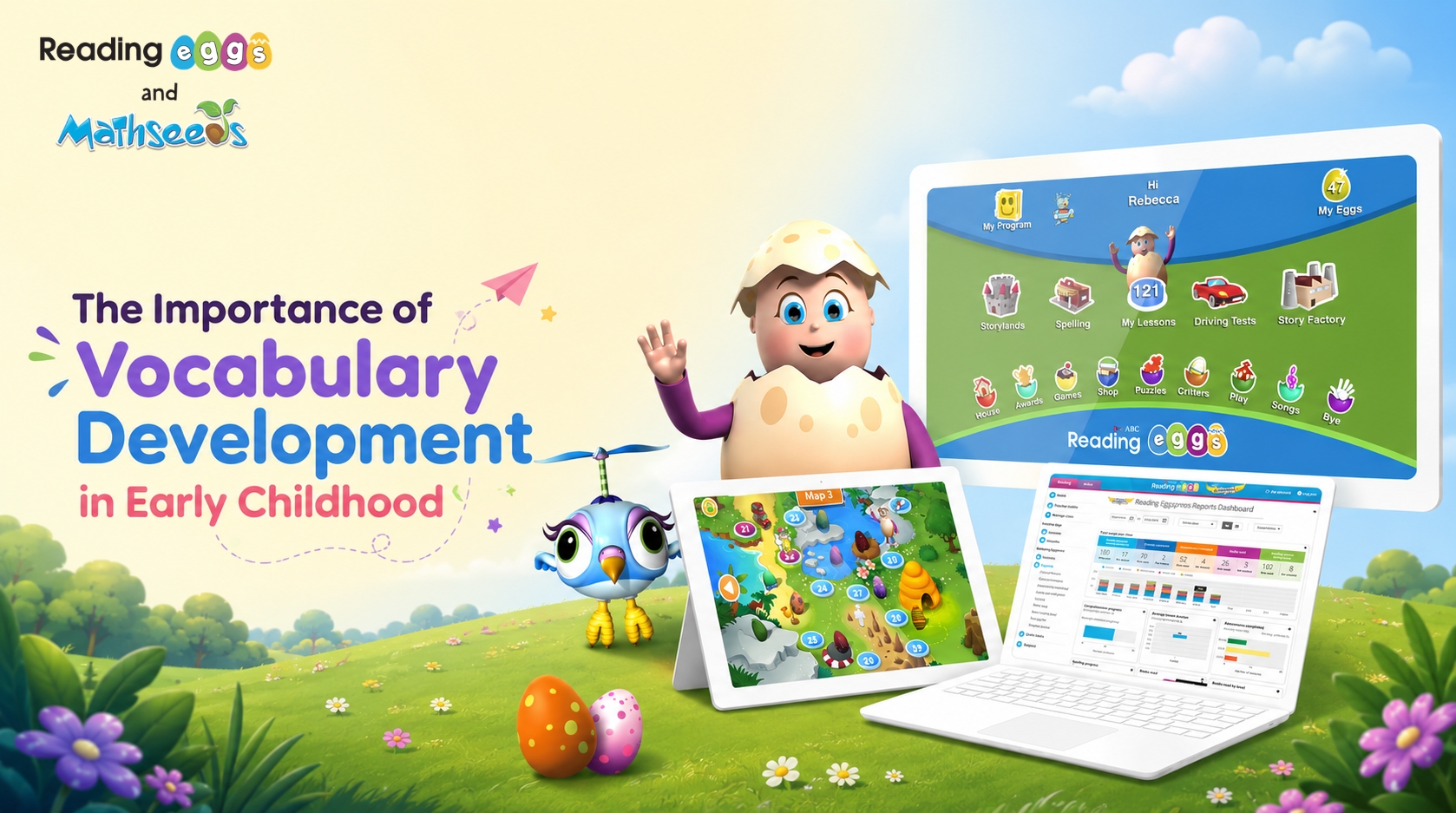
Building vocabulary takes consistency, and that is where Reading Eggs and Mathseeds — available at re.rsgr.in — become invaluable tools for Indian parents preparing their children for Class 1.
Reading Eggs — Vocabulary Through Stories and Phonics
Reading Eggs is a research-backed programme for children aged 2–13 that builds reading skills from the ground up. Its approach to vocabulary is embedded and contextual — children do not memorise word lists. Instead, they encounter words in stories, games, and interactive lessons that make meaning stick.
What makes it particularly effective for pre-Class 1 vocabulary:
- Phonics-based word building helps children decode unfamiliar words independently, so new vocabulary never feels intimidating
- Hundreds of levelled books expose children to rich, varied language across classroom, nature, feelings, and descriptive vocabulary — exactly the categories that matter most before school
- Interactive comprehension activities reinforce understanding, not just word recognition
- The programme uses purposeful repetition within engaging stories, so children encounter the same words in multiple contexts — which is how lasting vocabulary acquisition genuinely works
Mathseeds — Number and Shape Vocabulary Through Play
Vocabulary for Class 1 is not limited to language arts. Mathematical language is equally important — and often underestimated by parents. Words like add, count, equal, more, less, shape, and half are the vocabulary your child will encounter in their very first maths lessons.
Mathseeds, designed for ages 3–9, teaches precisely these concepts through vibrant, game-based lessons. By the time your child walks into Class 1, mathematical vocabulary will already feel familiar — giving them a confident head start that is visible from the very first lesson.
A Simple Daily Routine That Works
You do not need hours of structured study. Here is a simple, sustainable daily habit:
- 5 minutes on Reading Eggs — one lesson or one levelled book
- 5 minutes on Mathseeds — one activity or number game
- At bedtime — read one picture book together and chat about any new words that came up during the day
Ten minutes of purposeful, consistent practice builds a remarkable vocabulary over weeks and months — without any pressure, stress, or resistance from your child.
Vocabulary words for kids before Class 1 are not just about academic preparation — they are about giving your child the confidence to communicate, question, and connect with the world around them.
Every conversation, every story, every game adds to the reservoir your child will draw from when they step into that classroom for the first time. The earlier you start, the richer that reservoir becomes.
Support their journey with tools that make learning feel like an adventure. Start your free trial of Reading Eggs and Mathseeds today at and watch the words begin to flow.